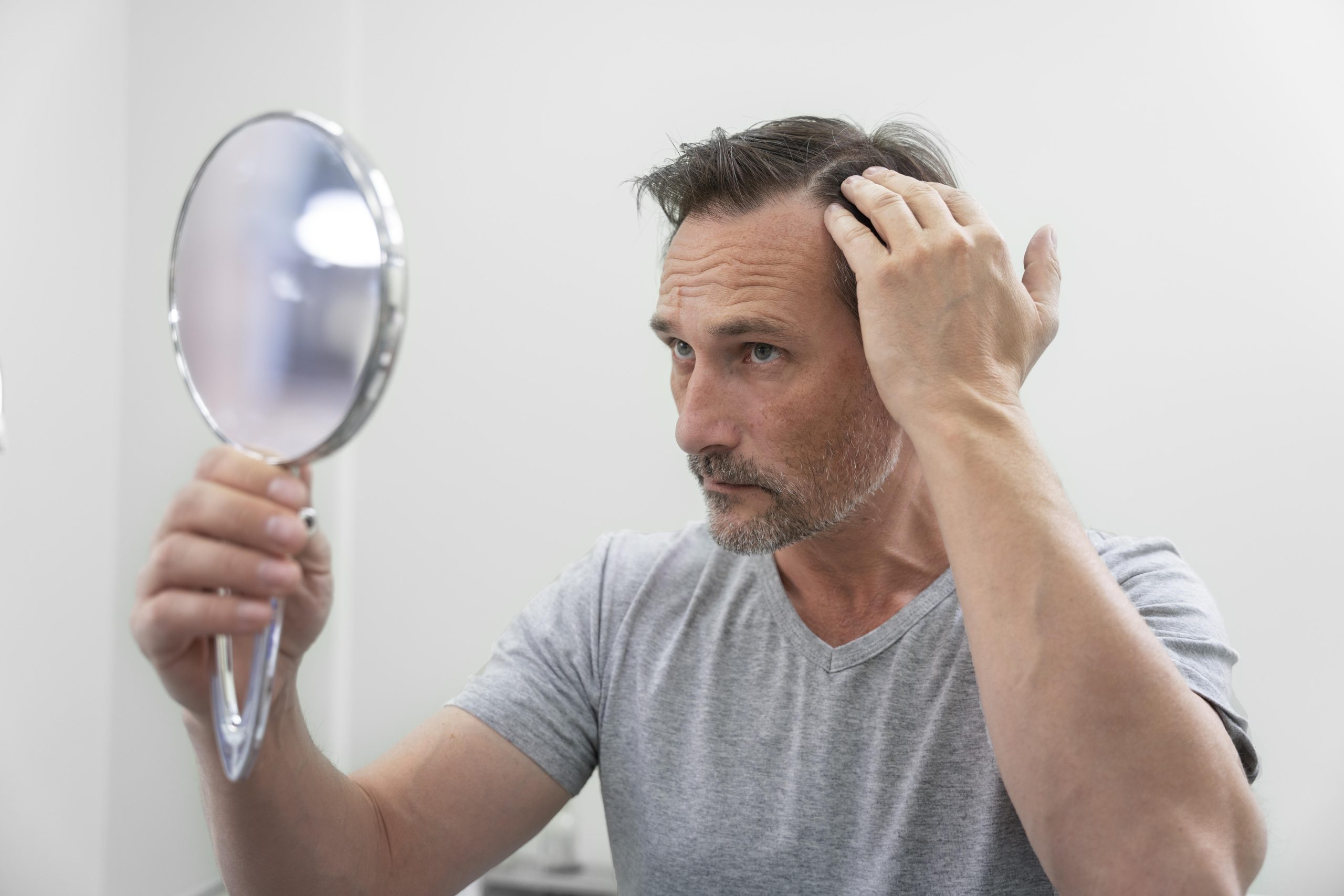
Hi, gentlemen I understand your situation. Running your fingers through what used to be a thick mane while standing in front of that mirror, you find yourself suddenly confronted with a reality that seems to have appeared out of nowhere. That hairline that once framed your face perfectly? It’s making a strategic retreat, and you’re not even close to 30 yet.
This is the truth no one talks about: discovering a receding hairline at 25 isn’t just about vanity – it’s watching your identity shift before your very eyes. But listen to this: this moment, this epiphany, can be your final setback or your greatest comeback story. That’s your choice. Understanding how much hair loss is normal is the first step in taking control of your situation.
The statistics don’t lie – up to 80% of androgenetic alopecia risk comes down to genetics. Your DNA loaded the gun, and sometimes life pulls the trigger early. But genetics isn’t destiny, my friend. It’s just the starting point of your story.

Understanding Your Receding Hairline: The Science Behind Early Hair Loss
Before we dive into solutions, you need to understand your opponent. Consider this like studying your competition before the big game. Male pattern baldness is a well-established biological process, and your first line of defense is knowledge. It is not some enigmatic curse. If you want to dig deeper, learn about the main cause of hair loss and how it affects men in their 20s.
How DHT Attacks Your Hair Follicles
Dihydrotestosterone (DHT) is the name of the antagonist in this tale. This hormone is similar to that party guest who stays late. Your once-thick hair strands become fine, feeble whispers of their former selves as DHT shrinks your hair follicles and shortens the hair growth cycle. Eventually, those follicles just give up entirely.
But here’s where it gets interesting – and where your power lies. DHT does not attack your scalp like a blind biological terrorist. It has patterns, weaknesses, and more importantly, it can be interrupted, redirected, and even defeated with the right strategy.
The Genetic Factor in Male Pattern Baldness
Your family history might have handed you this challenge, but environmental factors are playing a significant role too. Smoking has been linked to hair loss, poor nutrition creates deficiencies that sabotage hair growth, and chronic stress? It would resemble putting fuel on a fire. The good part is, unlike your genes, which you are essentially born with, you can actually alter these things.
Yes, your genetic makeup might lead you to experience some issues, but what you do every day is really what determines whether those issues ever come to pass. You’re stuck with whatever chromosomes you inherited from your parents, but you sure as heck can be the one who determines how your body reacts to those genetic signals.
Environmental Triggers That Accelerate Hair Loss
It is impossible to overstate the psychological effects of early hair loss. Research shows that men with full hair are more likely to be invited for job interviews compared to their balding counterparts. This isn’t about fairness – it’s about understanding the game we’re playing and positioning yourself to win regardless.
I’ve seen talented, accomplished men completely distracted by something as apparently harmless as going bald. The shyness, embarrassment, and sadness that accompany a receding hairline at 25 can create a snowball effect that mars all aspects of your life. But I’ve also seen people use this problem as the push that launches the most productive period of their lives.
Proven Treatments for Receding Hairlines in Your 20s
Now let’s talk solutions – real, proven, scientifically-backed strategies that can not only halt your hair loss but potentially reverse it. This has nothing to do with miracle cures or snake oil salesmen. This is about leveraging decades of research and clinical trials to build your comeback strategy. For cutting-edge options, explore the new generation of hair loss treatments available today.
FDA-Approved Medications: What Actually Works
Some FDA-approved medications have helped in hair loss treatment. By inhibiting the enzyme that changes testosterone into DHT, one of these medications, when taken as a daily 1 mg pill, works to keep the troublemaker out. It’s similar to placing a bouncer at the door. Clinical studies show that this combination approach delivers significant results when used consistently.
Another, when applied twice a day as a 5% solution or foam has a different effect. By increasing blood flow and motivating those dormant follicles to resume their function, it functions similarly to a personal trainer for your hair follicles. The benefit of combining the two is that you can simultaneously approach the problem from two different angles.
But this is where individuals differ – you want to be seeing incredible results next week. Reality check? Real change takes three to six months to manifest, so be patient. Focus on this more as marathon training rather than sprinting to the end. The individuals that do succeed are those who persevere throughout all of the dull, mundane moments when it seems like nothing is happening.
Low-Level Laser Therapy (LLLT) Explained
As more people search for innovative treatments outside of the box, low-level laser therapy (LLLT) is becoming more and more popular. Certain light wavelengths, approximately 655 nm, are emitted by these devices, which encourage circulation to your hair follicles. Think of it as photosynthesis for your scalp. The body of research on LLLT is expanding, and although it is most effective when used in conjunction with other strategies, it is just one more tool in your toolbox.
Understanding Side Effects and Risks
Let’s now tackle the most pressing issue: adverse effects. Some hair loss medications may cause side effects in users, including emotional changes and sexual dysfunction. This is the case, and that is why having a doctor to collaborate with isn’t optional. But the attitude shift is this: all powerful tools carry risks. The question is whether or not the rewards are going to outweigh the risks for your specific situation.
The actual question is whether, in your particular case, the advantages will be worth the potential risks. There has been widespread argument in the medical establishment regarding the long-term side effects some individuals have reported, even after the medication has stopped being taken. Due to this, combination therapies are gaining favor. By utilizing multiple approaches, you are likely to achieve better results employing smaller quantities of single treatments and then decreasing risk of side effects.
For those concerned about traditional medications, topical alternatives are emerging. Topical FDA-approved medications deliver the hormone-blocking benefits directly to the scalp with potentially fewer systemic effects. It’s like having a sniper instead of a shotgun – more precise, potentially safer, but still effective. You can also explore natural ways to stop a receding hairline as complementary strategies.
Lifestyle Changes That Support Hair Regrowth
This is where we separate the amateurs from the professionals: understanding that your hair loss treatment extends far beyond what you put on your scalp or swallow in pill form. Your entire lifestyle becomes part of the treatment protocol.
The Hair-Healthy Diet: Essential Nutrients
Let’s start with diet, since your hair is literally built out of what you eat. Think of your hair follicles as tiny factories, and factories need raw materials in order to produce their product. Dietary deficiencies, namely iron, vitamin B12, and protein, are established triggers of hair loss. For a complete breakdown, read about the 7 essential nutrients your hair follicles need.
The Mediterranean diet has shown promise for enhancing hair health in individuals with thinning hair. This isn’t about sticking to some strict diet plan – it’s about giving your body the nutrients it craves for healthy hair growth. We’re talking about healthy fats, high-quality proteins, and colorful vegetables. Of course, your hair restoration strategy can also include that evening glass of red wine.
The correct supplements can definitely give you that added spark you’re looking for. Supplements like biotin, collagen peptides, and omega-3s have been shown to give some very real results in getting your hair to grow. Just remember one thing, however – these work best if you’re already eating a solid diet. Use them like adding gasoline to an already burning fire, not like trying to strike a match in the rain.
Stress Management for Hair Preservation
Let’s now discuss chronic stress, the invisible killer of hair follicles. Stress can worsen pre-existing hair loss conditions and disrupt normal hair growth cycles. Your body puts survival before beauty when you’re always in fight-or-flight mode. Because, from a biological perspective, being attractive does not help you avoid a saber-toothed tiger, hair growth is neglected.
A vicious cycle is produced by the relationship between stress and hair loss. You are caught in a vicious cycle where stress causes hair loss, which causes more stress. Intentional stress management techniques are necessary to break this cycle.
Sleep, Exercise, and Your Hairline
Your scalp and body both benefit from exercise. The benefits of exercise cannot be over-emphasized because exercise improves blood circulation, feeds your follicles, and helps regulate stress hormones. No matter the activity you pick: whether it’s yoga, running or going to the gym, make it a priority. Learn more about the connection between sleep, exercise, and hair health.
While you’re asleep, the magic happens. Your body enters repair mode when you get enough sleep, repairing damaged cells, including those in your hair follicles, and releasing growth hormone. A healthy hair routine must include getting enough sleep. Seven to nine hours is a need, not a luxury.
You’ll probably want to rethink how you’re taking care of your hair too. Sulfate-free shampoos actually do help prevent more damage, and if you massage your scalp gently, you’ll get better blood flow up there. It’s basically like giving your scalp its own little workout routine.
However, scalp health is the game-changer that most people totally ignore. Think about it – if you’re trying to grow a garden in crappy soil, you’re not going to get much. Your scalp works the same way. When you massage it regularly with something like coconut oil or other natural oils, you’re basically getting more blood moving around up there and creating the right environment for your hair to actually thrive. For comprehensive prevention strategies, check out our guide on understanding and preventing hair loss in men.

The Mental Game: Building Confidence Through Hair Loss
How people deal with the psychological and emotional effects of hair loss is what distinguishes those who thrive from those who only make it through this difficulty. This is about becoming the person you were destined to be, not just about getting your hair back.
Overcoming the Psychological Impact
The psychological effects of hair loss at age 25 can be disastrous. Instead of feeling invincible and on top of your game, you’re going through something most people think occurs later in life. That sense of loss is valid and totally legitimate, and it’s naturally understandable when you start noticing these changes in your looks.
But here’s the shift in thinking that can change everything: what if this challenge is actually happening to help you grow, not just to mess with you? Look at any success story worth telling – there’s always that part where everything seemed to be falling apart before it got better. This could be your chapter.
Body dysmorphic disorder (BDD) may occur when hair loss makes one obsessive about imperfections in one’s appearance. Professional assistance becomes important at this stage. Getting expert help indicates that you are intelligent and strong, not weak.
When you meet people who understand your situation, and have experienced hair loss as well, it can literally give you a boost. You no longer feel alone, because speaking with someone who has actually been in your position strengthens you to overcome this condition. And everything just seems easier when you have that kind of support.
Self-acceptance is the ability to love oneself enough to act from strength rather than desperation. You can concentrate on your strengths besides your looks by using self-affirmations and self-worth reinforcement techniques. If you’re looking for practical styling solutions in the meantime, explore confidence-boosting styles for men with thinning hair.
This can be your chance to create the kind of confidence that nothing can pierce through – the kind that does not depend on your looks or on what’s happening in the world around you. Every aspect of your life will improve, when you are self-assured, regardless of your hair condition.
Your Next Steps: Taking Action Today
Your value as a person is not in the quantity of hairs on your head. Your individuality, distinctiveness, and ability to make a difference in people’s lives are what make you worth something. Hair loss can transform your appearance, but it does not get to transform your story.
One thing unites the most successful individuals I know who have experienced early hair loss: they refused to allow it to define who they are. Rather, they fueled their success, confidence, and attractiveness in all the important ways.
When you are 25, your receding hairline is not the end of the world but the beginning of a new world for you – an era where you assert yourself, make intelligent choices, and show yourself that you can beat any adversity that comes your way. Early intervention is your greatest advantage. It now boils down to this: are you prepared to make a change and write your own success story?
Here’s where you make the next decision. Your future self is being shaped by the decisions you make today. Make them count.