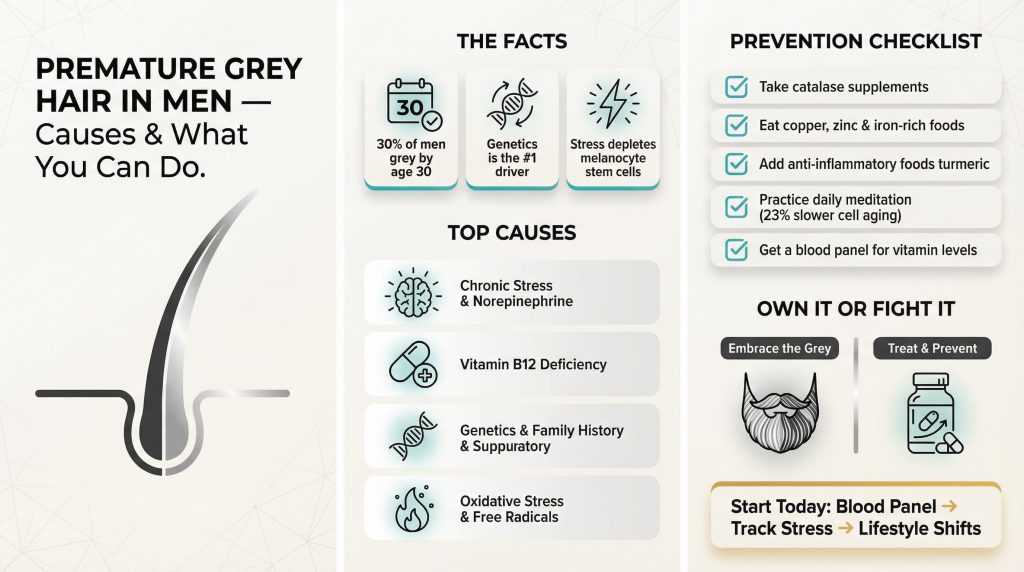
The early onset of premature grey hair is a common occurrence and affects a significant portion of the population. While this process of graying has been mainly attributed to the aging process related to genetic factors, current research is indicating that there may be more to it. Lifestyle factors may influence hair pigmentation according to limited studies; outcomes vary and this is not medical advice.
Why Grey Hair Appears Before 30
Understanding the biological mechanisms behind early greying helps you make informed decisions about prevention and treatment.
Genetic Factors and Melanin Production
The most important factor regarding the timing and processes of hair turning gray is genetics. Studies show that as much as 90% of the variability in the process of hair graying is due to genetic factors, according to twin studies published by researchers in recent publications (Desai, 2024). It is important to note that genetics is not fate, as environmental factors may play a role in the expression of the graying process.
Melanocytes — specialized cells in your hair follicles — produce melanin, the pigment that gives your hair its color. When melanin production decreases or stops, grey hair appears. This process involves complex cellular mechanisms including melanocyte stem cells that must continuously regenerate pigment-producing cells.

How Stress Accelerates Greying
Novel research from Harvard University has established for certain the biological connection of stress to premature grey hair. Stress seems to promote the premature graying of hair through its effect on the stem cells that regenerate hair pigment (Bryant & Hsu, 2025). This is through a long chain of events controlled by the sympathetic nervous system, where the release of norepinephrine from a stressful event has damaging effects on the melanocyte stem cells in the hair follicles.
Columbia University researchers have made remarkable discoveries about the reversibility of stress-related graying. Though people have long believed that psychological stress can accelerate gray hair, scientists have debated the connection due to the lack of sensitive methods that can precisely correlate times of stress with hair pigmentation at a single-follicle level (Picard et al., 2021). A limited study by the researchers observed pigment return in a small sample; findings are preliminary. Learn more about the stress and scalp health connection.
Major Causes of Premature Greying
Multiple factors contribute to early grey hair, and understanding them empowers you to address root causes rather than just symptoms.
Nutritional Deficiencies That Trigger Grey Hair
Nutritional deficiencies play a surprisingly significant role in premature greying. Your body requires specific vitamins and minerals to maintain melanin production in hair follicles.
Vitamin B12 Deficiency
Several studies have reliably shown an association between vitamin B12 deficiency and premature graying. A study looking at young adults experiencing premature graying found that over 38% of those patients had a vitamin B12 deficiency, making vitamin B12 deficiency to once again be introduced as a factor leading to premature graying. In addition, patients with pernicious anemia showed that, compared to a control group that did not have an issue with B12 deficiency, 30% of patients without pernicious anemia had prematurely graying hair and an astonishing 55% of individuals experiencing pernicious anemia had the same (Daulatabad et al., 2018).
Medical literature indicates that vitamin B12 plays an important role in cell metabolism and DNA synthesis which may be the link to a reason for altered hair pigmentation associated with vitamin B12 deficiency. One case report documented reversible hyperpigmentation of skin and nails, and premature graying of hair secondary to viral infection, all of which were due to vitamin B12 deficiency (Noppakun & Swasdikul, 1987), suggesting that nutritional deficiency may be reversible.
Discover the essential nutrients for hair follicles including B12 and iron.
Iron, Copper, and Zinc Deficiency
Some trace element deficiencies may also be implicated in premature greying, including vitamin B12, vitamin D3, and calcium (Bhat et al., 2016). Iron deficiency affects oxygen delivery to hair follicles, while copper and zinc are essential for melanin synthesis. In addition, several essential minerals (copper, zinc, and iron) are needed for both melanin production and hair follicle properties.
Include foods that combat thinning hair in your diet to address nutritional gaps.
Environmental and Lifestyle Triggers
Your daily environment and lifestyle choices significantly impact hair pigmentation. Understanding the environmental triggers of premature greying empowers you to make protective changes.
UV Radiation and Pollution Damage
UV radiation from sunlight causes both melanin degradation and protein damage in hair fibers, accelerating color loss. The cumulative daily effects of UV exposure — even when cloudy or through windows — continuously damage your hair’s pigment-producing cells. Urban pollution exposes your hair to chemical substances that promote premature pigment loss through oxidative stress.
Smoking and Oxidative Stress
Smoking accelerates grey hair development dramatically — smokers develop grey hair two and a half times faster than non-smokers. Cigarette smoke generates massive amounts of free radicals that attack melanocytes, disrupting the cellular machinery responsible for pigment production. Antioxidants and melanin protection are linked through this mechanism of oxidative stress.
Hormonal Imbalances and Thyroid Function
Thyroid function directly influences hair pigmentation through complex hormonal pathways. Hypothyroidism slows metabolism throughout your body, including the pigmentation processes in hair follicles. Learn about thyroid disorders and premature greying connection. Your thyroid gland sends direct instructions to hair follicles about pigment production, and thyroid dysfunction disrupts these signals.
Grey hair often precedes hair loss in young men, making early intervention crucial.
Proven Solutions to Slow and Reverse Greying
While genetics load the gun, lifestyle pulls the trigger. Evidence-based interventions can slow, and in some cases partially reverse, premature greying.
Nutritional Optimization Strategy
Current research indicates that adequate intake of specific nutritional components is necessary for hair pigmentation:
Vitamin B12: Particularly important for vegetarians and vegans as they usually have limited dietary sources. Aim for 2.4 mcg daily from fortified foods or supplements.
Copper: Needed for the synthesis of melanin. Found in shellfish, nuts, seeds, and whole grains.
Iron: Important for overall health of hair follicles. Pair iron-rich foods with vitamin C for enhanced absorption.
Zinc: Important for cellular processes in hair follicles. Found in oysters, beef, pumpkin seeds, and lentils.
The dietary approach must extend beyond isolated nutrients. Include folate, vitamin D, vitamin E, and selenium from whole food sources like fatty fish, dark leafy greens, nuts, and legumes. The goal is to maximize nutrient absorption and synergistic benefits, not just consume isolated supplements.
Stress Management Techniques
Using efficient stress management techniques may help maintain natural hair color given the proven link between stress and early graying. Methods backed by research include:
Mindfulness exercises and meditation: Just 10-15 minutes daily can reduce cortisol and protect melanocyte stem cells from stress-induced damage.
Frequent exercise: Monitor intensity to prevent overstress. Moderate exercise reduces oxidative stress while boosting circulation to hair follicles.
Proper sleep hygiene: Sleep quality directly affects cellular repair mechanisms. Aim for 7-9 hours nightly to support melanocyte regeneration.
Professional counseling: When necessary, seek professional counseling for stress management to address chronic psychological stress that accelerates greying.
Antioxidant and Supplement Support
A complex interaction of cellular, environmental, and genetic factors causes premature graying of hair (PMGH) (Sengupta et al., 2024). Antioxidants may aid in the fight against oxidative stress, which is a factor in pigment loss and follicle aging.
Key antioxidants for hair pigmentation include vitamin E, vitamin C, catalase, and selenium. These compounds neutralize free radicals that damage melanocytes. While whole food sources are ideal, targeted supplementation can support cellular function when dietary intake is insufficient.
Establish a proper hair care routine for men to protect pigmentation from environmental damage.
Clinical Evaluation: When to See a Doctor
For individuals experiencing premature graying, comprehensive evaluation may include:
Complete blood panel including vitamin B12, folate, and iron studies to identify nutritional deficiencies
Thyroid function tests to assess hormonal influences on pigmentation
Assessment of overall nutritional status and absorption issues
Evaluation of stress-related factors and lifestyle contributors
Blood panel testing can reveal underlying health issues that manifest as premature greying before other symptoms appear.
Realistic Expectations and Limitations
It is important to understand that in humans, most gray hair is not related to stress. In truth, hair does not “turn” gray. Following hair production by a follicle, the color of the hair is determined from that point (Shmerling, 2022). While certain interventions may delay the graying process or possibly reverse the recently grayed hair, full restoration to the original color is not always possible.
Current scientific data supports a multifactorial model of premature graying that investigates and treats this process. Genetic factors ultimately play an important role, but addressing some modifiable risk factors could yield some potential benefit. When evaluating premature graying, you may be able to alter oxidative stress, stress management, and nutritional deficiencies. For assistance in assessing and developing a treatment plan, anyone who is experiencing premature grey hair should speak with a licensed healthcare provider.
Learn more about embracing grey hair transition confidently, whether you choose prevention or acceptance.
Disclaimer: Educational content only. Not medical advice. Consult a professional before acting on information.
References
Bhat, R. M., Sharma, R., Pinto, A. C., Dandekeri, S., & Martis, J. (2016). Factors associated with premature hair graying in a young Indian population. International Journal of Trichology, 8(1), 11-14. https://pmc.ncbi.nlm.nih.gov/articles/PMC4830165/
Picard, M., PhD; Rosenberg, A.; & Paus, R., PhD. (2021, June 22). It’s true: Stress does turn hair gray (and it’s reversible). Columbia University Irving Medical Center. https://www.cuimc.columbia.edu/news/its-true-stress-does-turn-hair-gray-and-its-reversible
Daulatabad, D., Grover, C., Bharti, J., Sharma, V. K., & Singal, A. (2018). Premature graying of hair: Review with updates. International Journal of Trichology, 10(5), 198-203. https://pmc.ncbi.nlm.nih.gov/articles/PMC6290285/
Desai, V. (2024). Premature hair graying: A multifaceted phenomenon. International Journal of Dermatology. https://onlinelibrary.wiley.com/doi/10.1111/ijd.17580
Shmerling, R. H. (2022, March 24). Why does hair turn gray? Harvard Health Publishing. https://www.health.harvard.edu/blog/hair-turn-gray-2017091812226
Bryant, E., & Hsu, Y.-C., PhD. (2025, May 8). How stress causes gray hair. National Institutes of Health. https://www.nih.gov/news-events/nih-research-matters/how-stress-causes-gray-hair
Noppakun, N., MD; Swasdikul, D., MD. (1987). Reversible hyperpigmentation of skin and nails with white hair due to vitamin B12 deficiency. PubMed. https://pubmed.ncbi.nlm.nih.gov/3740873/
Sengupta, M., Handa, S., Sharma, V. K., & Kumaran, M. S. (2024). Premature graying of hair: Review with updates. Indian Journal of Dermatology, 69(5), 123-135. https://pmc.ncbi.nlm.nih.gov/articles/PMC11444426/
—